Technique
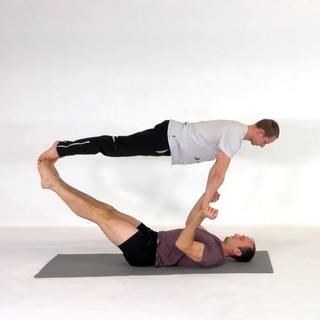
- The base lies face up with the arms extended so the hands are in line with the shoulders.
- The flyer stands at the base’s head with one foot by each of the base’s ears.
- The grip matters here: the flyer and base touch at the tips of the index and middle fingers, then the flyer traces those fingers down to the base’s wrist so they stay in line, forming a Hand-to-hand grip with an interlocked thumb, the ring and little fingers meeting the backs of the hands, and a slight suction through the palms.
- Once stable, the flyer lifts one leg at a time, engaging the Core to hold a tuck.
- To exit, the flyer lowers one leg at a time, taking care not to step on the base’s face.
Form tips
- Both partners aim for a straight line through their connected arms.
- The base engages the chest, while the flyer works more through the Latissimus dorsi and chest.
- The flyer keeps the gaze forward towards the base’s feet to keep the chest high.
Muscles
Strength

Primary
- Back
- Serratus anterior
- Chest
Secondary
- Pelvis
- Quadriceps
- Abs
- Obliques
- Hip adductors
Individual muscles
Individual muscles
- Lower trapezius
- Serratus anterior
- Latissimus dorsi
- Pectoralis minor
- Iliacus
- Rectus femoris
- Psoas major
- Rectus abdominis
- External oblique
- Internal oblique
Equipment
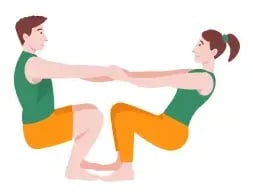
Appears in
Regressions
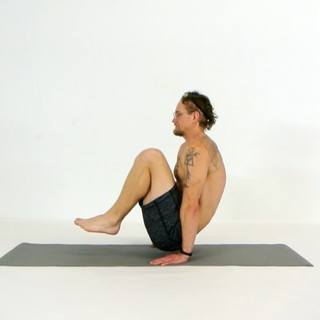
Tuck l-sit
Novice
View Similar Exercises
View Similar Exercises
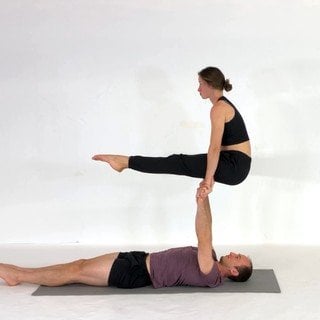
L-sit on hand
Intermediate
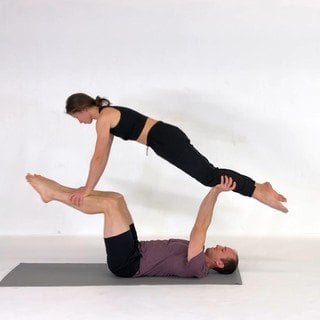
Bilateral jedi crawl
Intermediate

Long front plank fly pushup
Intermediate
Long front plank base pushup
Intermediate
High double pushup
Intermediate
Want to log this exercise? Open it in Calistree. Text and images are used under CC BY-NC-ND 4.0; the video plays from the original source.