Technique
- Sit facing the stern (you row backwards) and slide forward to the catch: knees bent with shins vertical, torso leaning forward from the hips, and arms straight, reaching the handle toward the stern.
- Take the catch by lifting the hands to drop the blade cleanly into the water, until its top edge sits just below the surface.
- Drive by pushing hard through your legs first, keeping the arms straight and the back braced so the leg power passes straight to the handle.
- As the legs near full extension, swing the torso open from the hips, then draw the handle into your lower ribs with the arms to finish the stroke.
- At the finish, tap the handle down to lift the blade out of the water, then feather it (rotate the blade flat).
- Recover in reverse order: extend the arms away, hinge the torso forward, then bend the knees to slide back to the catch, carrying the blade clear of the water.
Form tips
- Keep the sequence strict: legs, then back, then arms on the drive; arms, then back, then legs on the recovery.
- Stay connected through the first half of the drive: arms straight, hanging your bodyweight off the handle and letting the legs do the work.
- Bury the blade to full depth on the drive (top edge just under the surface) and carry it clear of the water on the recovery.
- Draw the handle in a straight, horizontal line to the base of your sternum.
- Drive powerfully but recover patiently: the slide back to the catch is slow and controlled, not rushed.
- Sit tall with a neutral spine, braced core, relaxed shoulders, and a level head throughout.
- A clean catch makes a small “V” splash and a crisp sound; a clean release leaves a smooth puddle with no dragging.
Muscles
Strength

Primary
- Quadriceps
- Glutes
- Hamstrings
- Rotator cuff
- Back
- Shoulders
- Triceps
- Biceps
- Forearms
Secondary
- Pelvis
- Hip adductors
- Legs
Flexibility
Secondary
- Glutes
- Hamstrings
- Hip adductors
Individual muscles
Individual muscles
- Rectus femoris
- Vastus medialis
- Vastus intermedius
- Vastus lateralis
- Gluteus maximus
- Semitendinosus
- Semimembranosus
- Biceps femoris (long)
- Teres minor
- Teres major
- Posterior deltoid
- Middle trapezius
- Latissimus dorsi
- Rhomboid major
- Triceps brachii (long head)
- Biceps brachii (short head)
- Brachialis
- Brachioradialis
Equipment
Appears in
Strength
Cardio
Joint movements
View Similar Exercises
View Similar Exercises

Erg Rowing
Beginner - Elite
Close squat
Novice
Deep squat
Beginner
Squat elbow tap
Novice
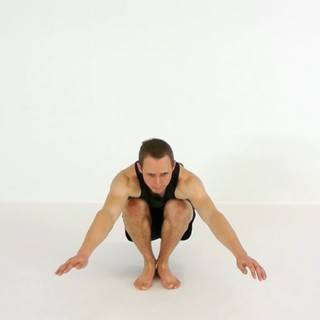
Basic Squats plus calves
Intermediate
Want to log this exercise? Open it in Calistree. Text and images are used under CC BY-NC-ND 4.0; the video plays from the original source.