Technique
- If you have done all the prerequisite drills and made it this far into your Handstand journey… Congratulations! The One-arm handstand is an incredibly rare display of strength. Regardless of one’s reason for pursuing it, the shared experience of patience, determination, practice, skill, and strength is a path few have the pleasure of experiencing. You will fall. A lot. Maybe even 20,000 times. Frustration is normal, but patience and consistency with the basic drills will significantly accelerate the process.
- See Straddle handstand with 5 fingers support series and use this as the starting position. It is recommended to start with 1 finger support position while learning, but switching to simply tenting and lifting can be done at a more advanced level.
- The lifted arm should be on the same plane as the bottom leg. However, arm angles and positions are a fun component to learn while balancing on one arm. Experimentation with slight position changes is encouraged to build up a better road map of what is possible to balance.
- The forearm and fingers should be very engaged and making frequent corrections. From an onlooker, it may appear as if your hand and forearm are rapidly twitching. (Personal preference: I do not like to grab the floor the entire handstand, as it wastes energy and creates too much tension resulting in a lower margin for error. I prefer to keep my wrist and fingers engaged and stable but relaxed enough to make quick floor grabbing twitches - Teagan)
- Both shoulders should be elevated and engaged - Do not let the Upper trapezius relax as the arm lifts from the floor. Both shoulders should be shrugging ( Shoulder elevation) the whole time.
- The hips should be slightly bent to allow a wide and stable Straddle position. The legs should be tense but relaxed enough to make quick corrections. The toes can be pointed or flexed - some people prefer to point the toes to assist in cueing global leg tension and creating straighter lines.
Logging: Work each side for the time indicated.
Muscles
Strength

Primary
- Back
- Serratus anterior
- Shoulders
- Neck
Secondary
- Forearms
Individual muscles
Individual muscles
- Lower trapezius
- Serratus anterior
- Posterior deltoid
- Upper trapezius
- Levator scapulae
Equipment
Appears in
Balance
Calisthenics skills
Joint movements
Progressions
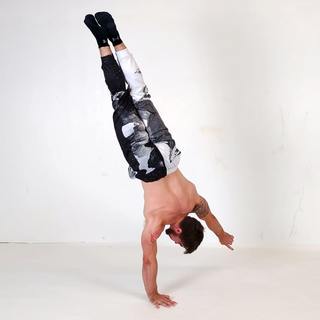
One-arm handstand
Herculean
Regressions
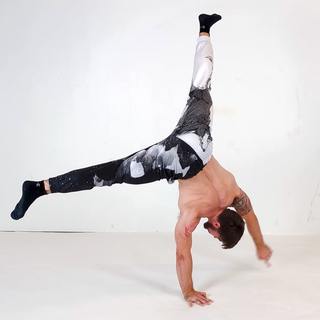
Straddle one-arm handstand fingertip tap
Herculean
View Similar Exercises
View Similar Exercises
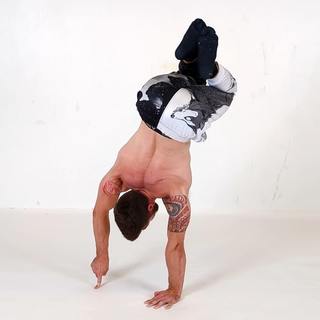
Tuck handstand with 1 finger support
Herculean
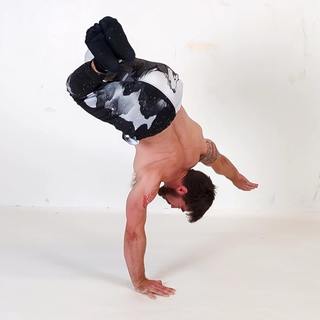
Tuck one-arm handstand
Herculean
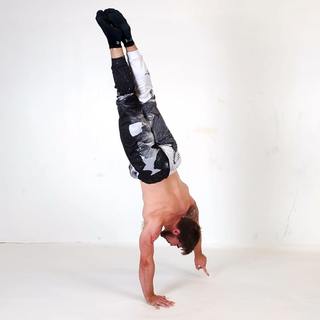
One-arm handstand fingertip tap
Herculean

Straddle handstand with 1 finger support
Herculean
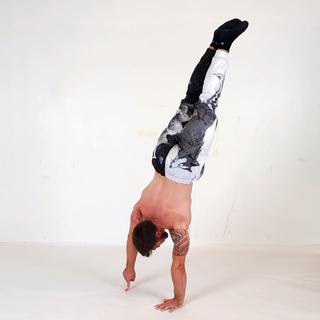
Handstand with 1 finger support
Herculean
Want to log this exercise? Open it in Calistree. Text and images are used under CC BY-NC-ND 4.0; the video plays from the original source.